Blog Archive

Wednesday, September 22, 2021

 Table 1 Tolerances (Clause 9) Sl No. Item Tolerance (1) (2) (3) i) a) Total losses b) Component losses (see Note 1) +10 percent of the total losses +15 percent of each component loss, provided that the tolerance for total losses is not exceeded ii) a) Voltage ratio at no load on principal tapping for a specified first pair of windings The lower of the following values: a) ±0.5 percent of declared ratio b) ±1/10 of the actual percentage impedance on the principal tapping b) Voltage ratio on other tappings, same pair To be agreed, but not less than the lesser of the values given in (a) and (b) above c) Voltage ratio for further pairs To be agreed, but not less than the lesser of the values given in (a) and (b) iii) Short-circuit impedance for: a) separate-winding transformer with two windings, or b) a specified first pair of separate windings in a multi-winding transformer 1) principal tapping When the impedance value is ≥10 percent ±7.5 percent of the declared value When the impedance value is <10 percent ±10 percent of the declared value 

 2) any other tapping of the pair When the impedance value is ≥10 percent ±10 percent of the declared value When the impedance value is <10 percent ±15 percent of the declared value iv) Short-circuit impedance for: a) an auto-connected pair of winding, or b) a specified second pair of separate windings in a multi-winding transformer 1) principal tapping ±10 percent of the declared value 2) any other tapping of the pair ±15 percent of the declared value for that tapping 3) further pairs of windings To be agreed, but ≥15 percent v) No-load current +30 percent of the declared value NOTES 1 The loss tolerances of multi-winding transformers apply to every pair of windings unless the guarantee states that they apply to a given load condition. 2 For certain auto-transformers and booster transformers the smallness of their impedance justifies more liberal tolerance. Transformers having large tapping ranges, particularly if the range is asymmetrical, may also require special consideration. On the other hand, for example, when a transformer is to be combined with previously existing units, it may be justified to specify and agree on narrower impedance tolerances. Matters of special tolerances shall be brought to attention at the tender stage, and revised tolerances agreed upon between manufacturer and purchaser. 


3 ‘Declared value’ should be understood as meaning the value declared by the manufacturer. Tests shall be made at any ambient temperature between 10 °C and 50 °C and with cooling water (if required) at any temperature not exceeding 30 °C. Tests shall be made at the manufacturer’s works, unless otherwise agreed between the manufacturer and the purchaser. All external components and fittings that are likely to affect the performance of the transformer during the test shall be in place. Tapped windings shall be connected on their principal tapping, unless the relevant test clause requires otherwise or unless the manufacturer and the purchaser agree otherwise. The test basis for all characteristics other than insulation is the rated condition, unless the test clause states otherwise. All measuring systems used for the tests shall have certified, traceable accuracy and be subjected to periodic calibration, according to IS/ISO 9001. Where it is required that test results are to be corrected to a reference temperature, this shall be: a) for oil-immersed transformers: 75 °C; and b) for dry-type transformers: according to the general requirements for tests in IS 11171. NOTE — Specific requirements on the accuracy and verification of the measuring systems are under consideration. 15 IS 2026 (Part 1) : 2011 10.1.1 Routine Tests a) Measurement of winding resistance (see 10.2); b) Measurement of voltage ratio and check of phase displacement (see 10.3); c) Measurement of short-circuit impedance and load loss (see 10.4); d) Measurement of no-load loss and current (see 10.5); e) Dielectric routine tests IS 2026 (Part 3); and f) Tests on on-load tap-changers, where appropriate (see 10.8). 10.1.2 Type Tests a) Temperature-rise test [see IS 2026 (Part 2)]; and b) Dielectric type tests [see IS 2026 (Part 3)]. 10.1.3 Special Tests a) Dielectric special tests [see IS 2026 (Part 3)]; b) Determination of capacitances windings-toearth, and between windings; c) Determination of transient voltage transfer characteristics; d) Measurement of zero-sequence impedance(s) on three-phase transformers (see 10.7); e) Short-circuit withstand test [see IS 2026 (Part 5)]; f) Determination of sound levels (see IS 13964); g) Measurement of the harmonics of the no-load current (see 10.6); h) Measurement of the power taken by the fan and oil pump motors; and j) Measurement of insulation resistance to earth of the windings, and/or measurement of dissipation factor (tan δ) of the insulation system capacitances. (These are reference values for comparison with later measurement in the field. No limitations for the values are given here.) If test methods are not prescribed in this standard, or if tests other than those listed above are specified in the contract, such test methods are subject to agreement. 10.2 Measurement of Winding Resistance 10.2.1 General The resistance of each winding, the terminals between which it is measured and the temperature of the windings shall be recorded. Direct current shall be used for the measurement. In all resistance measurements, care shall be taken that the effects of self-induction are minimized. 10.2.2 Dry-Type Transformers Before measurement the transformer shall be at rest in a constant ambient temperature for at least 3 h. Winding resistance and winding temperature shall be measured at the same time. The winding temperature shall be measured by sensors placed at representative positions, preferably inside the set of windings, for example, in a duct between the high-voltage and lowvoltage windings. 10.2 Oil-Immersed Type Transformers After the transformer has been under oil without excitation for at least 3 h, the average oil temperature shall be determined and the temperature of the winding shall be deemed to be the same as the average oil temperature. The average oil temperature is taken as the mean of the top and bottom oil temperatures. In measuring the cold resistance for the purpose of temperature-rise determination, special efforts shall be made to determine the average winding temperature accurately. Thus, the difference in temperature between the top and bottom oil should be small. To obtain this result more rapidly, the oil may be circulated by a pump. 10.3 Measurement of Voltage Ratio and Check of Phase Displacement The voltage ratio shall be measured on each tapping. The polarity of single-phase transformers and the connection symbol of three-phase transformers shall be checked. 10.4 Measurement of Short-Circuit Impedance and Load Loss The short-circuit impedance and load loss for a pair of windings shall be measured at rated frequency with approximately sinusoidal voltage applied to the terminals of one winding, with the terminals of the other winding short-circuited, and with possible other windings open-circuited (For selection of tapping for the test, see 5.5 and 5.6). The supplied current should be equal to the relevant rated current (tapping current) but shall not be less than 50 percent thereof. The measurements shall be performed quickly so that temperature rises do not cause significant errors. The difference in temperature between the top oil and the bottom oil shall be small enough to enable the mean temperature to be determined accurately. If the cooling system is OF or OD, the pump may be used to mix the oil. 16 IS 2026 (Part 1) : 2011 The measured value of load loss shall be multiplied with the square of the ratio of rated current (tapping current) to test current. The resulting figure shall then be corrected to reference temperature (see 10.1). The I2R loss (R being dc resistance) is taken as varying directly with the winding resistance and all other losses inversely with the winding resistance. The measurement of winding resistance shall be made according to 10.2. The temperature correction procedure is detailed in Annex F. The short-circuit impedance is represented as reactance and ac resistance in series. The impedance is corrected to reference temperature assuming that the reactance is constant and that the ac resistance derived from the load loss varies as described above. On transformers having a tapped winding with tapping range exceeding ±5 percent, the short-circuit impedance shall be measured on the principal tapping and the two extreme tappings. On a three-winding transformer, measurements are performed on the three different two-winding combinations. The results are re-calculated, allocating impedances and losses to individual windings. Total losses for specified loading cases involving all these windings are determined accordingly. NOTES 1 For transformers with two secondary windings having the same rated power and rated voltage and equal impedance to the primary (sometimes referred to as ‘dual-secondary transformers’), it may be agreed to investigate the symmetrical loading case by an extra test with both secondary windings short-circuited simultaneously. 2 The measurement of load loss on a large transformer requires considerable care and good measuring equipment because of the low power factor and the often large test currents. Correction for measuring transformer errors and for resistance of the test connections should be applied unless they are obviously negligible. 10.5 Measurement of No-load Loss and Current The no-load loss and the no-load current shall be measured on one of the windings at rated frequency and at a voltage corresponding to rated voltage if the test is performed on the principal tapping, or to the appropriate tapping voltage if the test is performed on another tapping. The remaining winding or windings shall be left open-circuited and any windings which can be connected in open delta shall have the delta closed. The transformer shall be approximately at factory ambient temperature. For a three-phase transformer the selection of the winding and the connection to the test power source shall be made to provide, as far as possible, symmetrical and sinusoidal voltages across the three wound limbs. The test voltage shall be adjusted according to a voltmeter responsive to mean value of voltage but scaled to read the r.m.s. voltage of a sinusoidal wave having the same mean value. The reading of this voltmeter is U′. At the same time, a voltmeter responsive to the r.m.s. value of voltage shall be connected in parallel with the mean-value voltmeter and its indicated voltage U shall be recorded. When a three-phase transformer is tested, the voltages shall be measured between line terminals, if a deltaconnected winding is energized, and between phase and neutral terminals if a YN or ZN connected winding is energized. The test voltage wave shape is satisfactory if the readings U′ and U are equal within 3 percent. The measured no-load loss is Pm, and the corrected no load loss is taken as: Po = Pm (1 + d) d = U U U ′ − ′ (usually negative) If the difference between voltmeter readings is larger than 3 percent, the validity of the test is subject to agreement. The r.m.s. value of no-load current is measured at the same time as the loss. For a three-phase transformer, the mean value of readings in the three phases is taken. NOTES 1 It is recognized that the most severe loading conditions for test voltage source accuracy are usually imposed by large single-phase transformers. 2 In deciding the place of the no-load test in the complete test sequence, it should be borne in mind that no-load loss measurements performed before impulse tests and/or temperature rise tests are, in general, representative of the average loss level over long time in service. Measurements after other tests sometimes show higher values caused by spitting between laminate edges during the impulse tests, etc. Such measurements may be less representative of losses in service. 10.6 Measurement of the Harmonics of the No-load Current The harmonics of the no-load current in the three phases are measured and the magnitude of the harmonics is expressed as a percentage of the fundamental component. 10.7 Measurement of Zero-Sequence Impedance(s) on Three-Phase Transformers The zero-sequence impedance is measured at rated 17 IS 2026 (Part 1) : 2011 frequency between the line terminals of a starconnected or zigzag-connected winding connected together, and its neutral terminal. It is expressed in ohms per phase and is given by 3 U/I, where U is the test voltage and I is the test current. The test current per phase 3 I shall be stated It shall be ensured that the current in the neutral connection is compatible with its current-carrying capability. In the case of a transformer with an additional deltaconnected winding, the value of the test current shall be such that the current in the delta-connected winding is not excessive, taking into account the duration of application. If winding balancing ampere-turns are missing in the zero-sequence system, for example, in a star-starconnected transformer without delta winding, the applied voltage shall not exceed the phase-to-neutral voltage at normal operation. The current in the neutral and the duration of application should be limited to avoid excessive temperatures of metallic constructional parts. In the case of transformers having more than one starconnected winding with neutral terminal, the zerosequence impedance is dependent upon the connection (see 3.7.3) and the tests to be made shall be subject to agreement between the manufacturer and the purchaser. Auto-transformers with a neutral terminal intended to be permanently connected to earth shall be treated as normal transformers with two star-connected windings. Thereby, the series winding and the common winding together form one measuring circuit, and the common winding alone forms the other. The measurements are carried out with a current not exceeding the difference between the rated currents on the low-voltage side and the high-voltage side. NOTES 1 In conditions where winding balancing ampere-turns are missing, the relation between voltage and current is generally not linear. In that case several measurements at different values of current may give useful information. 2 The zero-sequence impedance is dependent upon the physical disposition of the windings and the magnetic parts and measurements on different windings may not, therefore, agree. 10.8 Tests on On-load Tap-Changers 10.8.1 Operation Test With the tap-changer fully assembled on the transformer the following sequence of operations shall be performed without failure: a) with the transformer un-energized, eight complete cycles of operation (a cycle of operation goes from one end of the tapping range to the other, and back again); b) with the transformer un-energized, and with the auxiliary voltage reduced to 85 percent of its rated value, one complete cycle of operation; c) with the transformer energized at rated voltage and frequency at no load, one complete cycle of operation; and d) with one winding short-circuited and, as far as practicable, rated current in the tapped winding, 10 tap-change operations across the range of two steps on each side from where a coarse or reversing changeover selector operates, or otherwise from the middle tapping. 10.8.2 Auxiliary Circuits Insulation Test After the tap-changer is assembled on the transformer, a power frequency test shall be applied to the auxiliary circuits as specified in IS 2026 (Part 3). 11

 ELECTROMAGNETIC COMPATIBILITY (EMC) Power transformer shall be considered as passive elements in respect to emission of, and immunity to, electromagnetic disturbances. NOTES 1 Certain accessories may be susceptible to electromagnetic interference. 2 Passive elements are not liable to cause electromagnetic disturbances and their performance is not liable to be affected by such disturbances


Type of Transformer Testing

Tests done at factory

  1. Type tests
  2. Routine tests
  3. Special tests

Tests done at site

  1. Pre-commissioning tests
  2. Periodic/condition monitoring tests
  3. Emergency tests
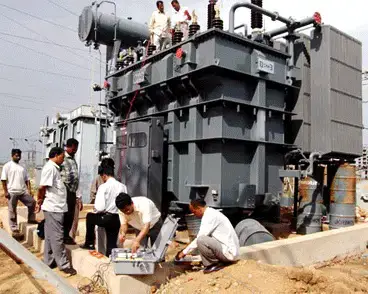
Men doing routine testing on a transformer

Type Test of Transformer

To prove that the transformer meets customer’s specifications and design expectations, the transformer has to go through different testing procedures in manufacturer premises. Some transformer tests are carried out for confirming the basic design expectation of that transformer. These tests are done mainly in a prototype unit not in all manufactured units in a lot. Type test of transformer confirms main and basic design criteria of a production lot.

Routine Tests of Transformer

Routine tests of transformer is mainly for confirming the operational performance of the individual unit in a production lot. Routine tests are carried out on every unit manufactured.

Special Tests of Transformer

Special tests of transformer is done as per customer requirement to obtain information useful to the user during operation or maintenance of the transformer.

Pre Commissioning Test of Transformer

In addition to these, the transformer also goes through some other tests, performed on it, before actual commissioning of the transformer at the site. The transformer testing performed before commissioning the transformer at the site is called the pre-commissioning test of transformer. These tests are done to assess the condition of transformer after installation and compare the test results of all the low voltage tests with the factory test reports.

Type tests of transformer include:

  1. Winding resistance test of transformer
  2. Transformer ratio test
  3. Transformer vector group test
  4. Measurement of impedance voltage/short circuit impedance (principal tap) and load loss (Short circuit test)
  5. Measurement of no-load loss and current (Open circuit test)
  6. Measurement of insulation resistance
  7. Dielectric tests of transformer
  8. Temperature rise test of transformer
  9. Tests on on-load tap-changer
  10. Vacuum tests on tank and radiators

Routine tests of transformer include

  1. Winding resistance test of transformer
  2. Transformer ratio test
  3. Transformer vector group test
  4. Measurement of impedance voltage/short circuit impedance (principal tap) and load loss (Short circuit test)
  5. Measurement of no load loss and current (Open circuit test)
  6. Measurement of insulation resistance
  7. Dielectric tests of transformer.
  8. Tests on on-load tap-changer.
  9. Oil pressure test on transformer to check against leakages past joints and gaskets

That means Routine tests of transformer include all the type tests except temperature rise and vacuum tests. The oil pressure test on transformer to check against leakages past joints and gaskets is included.

Special Tests of transformer include

  1. Dielectric tests.
  2. Measurement of zero-sequence impedance of three-phase transformers
  3. Short-circuit test
  4. Measurement of acoustic noise level
  5. Measurement of the harmonics of the no-load current.
  6. Measurement of the power taken by the fans and oil pumps.
  7. Tests on bought out components / accessories such as buchhloz relay, temperature indicators, pressure relief devices, oil preservation system etc.

Transformer Winding Resistance Measurement

Transformer winding resistance measurement is carried out to calculate the I2R losses and to calculate winding temperature at the end of a temperature rise test. It is carried out as a type test as well as routine test. It is also done at site to ensure healthiness of a transformer that is to check loose connections, broken strands of conductor, high contact resistance in tap changers, high voltage leads and bushings etc.

There are different methods for measuring of the transformer winding, likewise:

  • Current-voltage method of measurement of winding resistance.
  • Bridge method of measurement of winding resistance.
  • Kelvin bridge method of Measuring Winding Resistance.
  • Measuring winding resistance by Automatic Winding Resistance Measurement Kit.

Note: Transformer winding resistance measurement shall be carried out at each tap.

Transformer Ratio Test

The performance of a transformer largely depends upon perfection of specific turns or voltage ratio of transformer. So transformer ratio test is an essential type test of transformer. This test also performed as a routine test of transformer. So for ensuring proper performance of electrical power transformer, voltage and turn ratio test of transformer one of the important tests.

The procedure of the transformer ratio test is simple. We just apply three phase 415 V supply to HV winding, with keeping LV winding open. We measure the induced voltages at HV and LV terminals of the transformer to find out actual voltage ratio of the transformer. We repeat the test for all tap position separately.

Magnetic Balance Test of Transformer

Magnetic balance test of transformer is conducted only on three-phase transformers to check the imbalance in the magnetic circuit.

Procedure of Magnetic Balance Test of Transformer

  1. Keep the tap changer of transformer in normal position.
  2. Now disconnect the transformer neutral from ground.
  3. Then apply single phase 230 V AC supply across one of the HV winding terminals and neutral terminal.
  4. Measure the voltage in two other HV terminals in respect of neutral terminal.
  5. Repeat the test for each of the three phases.
transformer testing table

In case of an autotransformer, a magnetic balance test of transformer should be repeated for LV winding also.

There are three limbs placed side by side in a core of the transformer. One phase winding is wound in one limb. The voltage induced in different phases depends upon the respective position of the limb in the core. The voltage induced in different phases of a transformer in respect to neutral terminals given in the table below.

Magnetizing Current Test of Transformer

Magnetizing current test of transformer is performed to locate defects in the magnetic core structure, shifting of windings, failure in between turn insulation or problem in tap changers. These conditions change the effective reluctance of the magnetic circuit, thus affecting the current required to establish flux in the core.

  1. Keep the tap changer in the lowest position and open all IV and LV terminals
  2. Then apply three phase 415 V supply on the line terminals for three-phase transformers and single phase 230 V supply on single phase transformers
  3. Measure the supply voltage and current in each phase
  4. Now repeat the magnetizing current test of transformer test with keeping tap changer in normal position
  5. Repeat the test while keeping the tap at highest position

Normally, there are two similar higher readings on two outer limb phases on transformer core and one lower reading on the center limb phase, in the case of three phase transformers.

An agreement to within 30% of the measured exciting current with the previous test is usually considered satisfactory. If the measured exciting current value is 50 times higher than the value measured during factory test, there is a likelihood of a fault in the winding which needs further analysis.

Caution: This magnetizing current test of a transformer is to be carried out before DC resistance measurement.

Vector Group Test of Transformer

In a 3 phase transformer, it is essential to carry out a vector group test of transformer. Proper vector grouping in a transformer is an essential criteria for parallel operation of transformers.

There are several internal connections of three-phase transformer are available on the market. These several connections give various magnitudes and phase of the secondary voltage; the magnitude can be adjusted for parallel operation by suitable choice of turn ratio, but the phase divergence cannot be compensated.

So we have to choose a transformer suitable for parallel operation whose phase sequence and phase divergence are same. All the transformers with the same vector ground have same phase sequence and phase divergence between primary and secondary.

Before procuring an electrical power transformer, you should ensure the vector group of the transformer, whether it will be matched with his or her existing system or not. The vector group test of transformer confirms his or her requirements.

Insulation Resistance Test or Megger Test of Transformer

Insulation resistance test of transformer is essential type test. This test is carried out to ensure the healthiness of the overall insulation system of an electrical power transformer.

Procedure of Insulation Resistance Test of Transformer

  1. Disconnect all the line and neutral terminals of the transformer
  2. Megger leads to be connected to LV and HV bushing studs to measure insulation resistance IR value in between the LV and HV windings
  3. Megger leads to be connected to HV bushing studs and transformer tank earth point to measure insulation resistance IR value in between the HV windings and earth
  4. Megger leads to be connected to LV bushing studs and transformer tank earth point to measure insulation resistance IR value in between the LV windings and earth

NB: It is unnecessary to perform insulation resistance test of transformer per phase wise in three-phase transformer. IR values are taken between the windings collectively as because all the windings on HV side are internally connected together to form either star or delta and also all the windings on LV side are internally connected together to form either star or delta.

Measurements are to be taken as follows:

  • For autotransformer: HV-IV to LV, HV-IV to E, LV to E.
  • For two winding transformer: HV to LV, HV to E, LV to E.
  • Three winding transformers: HV to IV, HV to LV, IV to LV, HV to E, IV to E, LV to E.
  • Oil temperature should be noted at the time of insulation resistance test of the transformer, since the IR value of transformer insulating oil may vary with temperature.
  • IR values to be recorded at intervals of 15 seconds, 1 minute and 10 minutes.
  • With the duration of application of voltage, IR value increases. The increase in IR is an indication of dryness of insulation.
  • Absorption coefficient = 1 minute value/15 secs. value.
  • Polarization index = 10 minutes value/1 minute value.

Dielectric Tests of Transformer

Dielectric test of a transformer is one kind of insulation test. This test is performed to ensure the expected overall insulation strength of the transformer. There are several tests performed to ensure the required quality of transformer insulation; the dielectric test is one of them. Dielectric test of the transformer is performed in two different steps.

First one is called Separate Source Voltage Withstand Test of transformer, where a single phase power frequency voltage of prescribed level, is applied on transformer winding under test for 60 seconds while the other windings and tank are connected to the earth, and it is observed that whether any failure of insulation occurs or not during the test.

The second one is the induced voltage test of Transformer where, three-phase voltage, twice of rated secondary voltage is applied to the secondary winding for 60 seconds by keeping the primary of the transformer open circuited.

The frequency of the applied voltage should be double of power frequency too. Here also if no failure of insulation, the test is successful.

In addition to dielectric tests of transformers, there are other types of test for checking insulation of transformer, such as lightning impulse test, switching impulse test and partial discharge test.

Induced Voltage Test of Transformer

The induced voltage test of the transformer is intended to check the inter-turn and line end insulation as well as main insulation to earth and between windings-

  1. Keep the primary winding of transformer open circuited.
  2. Apply three-phase voltage to the secondary winding. The applied voltage should be twice of the rated voltage of secondary winding in magnitude and frequency.
  3. The duration of the test shall be 60 seconds.
  4. The test shall start with a voltage lower than 1/3 the full test voltage, and it shall be quickly increased up to the desired value.

The test is successful if no breakdown occurs at full test voltage during the test.

Temperature Rise Test of Transformer

Temperature rise test of transformer is included in type test of transformer. In this test, we check whether the temperature-rising limit of the transformer winding and oil as per specification or not. In this type test of the transformer, we have to check oil temperature rise as well as winding temperature rise limits of an electrical transformer.

Friday, January 29, 2010

graphene for the next generation of electronics

Graphene, the hottest new material in electronics, is remarkably simple: a flat sheet of pure carbon rings—just one atom thick—that resembles chicken wire. But this unassuming structure has caught the attention of researchers at laboratories in the United Kingdom, Texas, and Georgia and even at IBM. They are studying graphene for a wide range of applications, from computer chips to communication devices to touch screens. It might even put a fresh spark into the electrical grid.

Consisting of a single layer of graphite, graphene is an allotrope of carbon that has been studied for decades. It did not seem technologically important, however, until scientists began looking at potential replacements for silicon in electronics. In 2004 physicists at the University of Manchester in England demonstrated a simple way to produce graphene—peeling off layers of graphite, a method known as mechanical exfoliation—spurring an explosion of research.

Graphene has several very appealing traits. Electrons meet much less resistance from graphene than they do from silicon, traveling through it more than 100 times as easily. And because graphene is essentially a two-dimensional material, building smaller devices with it and controlling the flow of electricity within them are easier than with three-dimensional alternatives like silicon transistors.

In a blown-up image from a scanning tunneling microscope, it looks just like an endless sheet of chicken wire: a simple flat sheet made up of a lattice of hexagons. But this nanoscopic material called graphene, first generally acknowledged to exist just five years ago, turns out to have a variety of unique, and potentially very useful, characteristics -- ones several researchers are actively trying to better understand and turn into real-world applications.

GRAPHENE
                   

                   Graphene, a form of the element carbon that is just a single atom thick, had been identified as a theoretical possibility as early as 1947. Even as Institute Professor Mildred Dresselhaus, her physicist husband Gene, and others were working in the 1960s with multiple layers of graphene, many scientists were saying that such an ultra-thin sheet of matter could never be found or even made. It was very controversial; there were many people who were skeptical.

Now that it has been found, with widely publicized results published in 2004 by researchers. They are focusing on how to harness its properties, and trying to find ways to produce it in sufficient quantity for extensive research and eventually for commercial applications.

Its unique electrical characteristics could make graphene the successor to silicon in a whole new generation of microchips, surmounting basic physical constraints limiting the further development of ever-smaller, ever-faster silicon chips.

Graphene could also substitute for copper to make the electrical connections between computer chips and other electronic devices, providing much lower resistance and thus generating less heat. And it also has potential uses in quantum-based electronic devices that could enable a new generation of computation and processing.

The mobility of electrons in graphene -- a measure of how easily electrons can flow within it -- is by far the highest of any known material. So is its strength, which is, pound for pound, 200 times that of steel. Yet like its cousin diamond, it is a remarkably simple material, composed of nothing but carbon atoms arranged in a simple, regular pattern.

get informed about symposiumz

www.symposiumz.net

   hi buddies,do u want to get information about symposiums .subscribe in this link given above and get informed about symposiums and conferrences takes place in all over india.

ARE U PREPARING FOR GATE ?


www.gateprep.com


  In this link one can join as member and then you can login into gate previous year papers and solution for that papers.you can take online test to know your level of preparation and you can post your doubts to get the solution from gate toppers and IIT guys.

Saturday, January 16, 2010

About Neutrinos


Neutrinos are tiny, possibly massless, neutral elementary particles which interact with matter via the weak nuclear force. The weakness  of the weak force gives neutrinos the property that matter is almost transparent to them. The sun, and all other stars, produce neutrinos copiously due to nuclear fusion and decay processes within the core. Since they rarely interact, these neutrinos pass through the sun and the earth (and you) unhindered. Other sources of neutrinos include exploding stars (supernovae), relic neutrinos (from the birth of the universe) and nuclear power plants (in fact a lot of the fuel's energy is taken away by neutrinos). For example, the sun produces over two hundred trillion trillion trillion neutrinos every second, and a supernova blast can unleash 1000 times more neutrinos than our sun will produce in its 10-billion year lifetime. Billions of neutrinos stream through your body every second, yet only one or two of the higher energy neutrinos will scatter from you in your lifetime.
In recent years, theoretical models of the sun have permitted detailed calculations of the number (or flux) of neutrinos released from the sun. Several neutrino experiments have detected solar neutrinos and found the flux was too low. It appears that far too few neutrinos are detected than can be consistent with the known energy output of the sun. This is known as the "Solar Neutrino Problem" (SNP).
The neutrino was proposed by Wolfgang Pauli in 1930; but it would be 26 years from then before the neutrino was actually detected. Pauli proposed the existence of the neutrino as a solution to a frustrating problem in a nuclear process called beta decay. It seemed that examination of the reaction products always indicated that some variable amount of energy was missing. Pauli concluded that the products must include a third particle, but one which didn't interact strongly enough for it to be detected. Enrico Fermi called this particle the neutrino which meant "little neutral one". In 1956 Reines and Cowan found evidence of neutrino interactions by monitoring a volume of cadmium chloride with scintillating liquid near to a nuclear reactor. Fred Reines was jointly award the Nobel Prize in physics in 1995 in part for this revolutionary work.
We know that the mass of the neutrino is approximately zero, but we are unsure how large the masses of the three individual neutrino types are because of the difficulty in detecting neutrinos. This is important because neutrinos are by far the most numerous particle in the universe (other than photons of light) and so even a tiny mass for the neutrinos can enable them to have an effect on the evolution of the Universe through their gravitational effects. There are other recent astrophysical measurements that provide information on the evolution of the Universe and it is interesting to seek complementary information by direct determinations of the masses of neutrinos.

Wednesday, December 9, 2009

Do u want to earn ?

U can start earn online by clicking adds in the following link:

http://www.lenkaclix.com/?ref=jeeva
http://www.upbux.com/r?r=jeeva
http://www.neobux.com/?r=jeevasathish


These links are good , it doesn't spam you.
conditions:
1.Do if u are using a same pc forever.
2.Don't create multiple accounts in  a same pc ,if that all accounts will be deleted.
3.create a paypal or alertpay account before sign up.
4.U can earn more by clicking adds and referring to ur friends.
all the best

Are you looking for a project?


This is a very useful site ,which gives more electronics projects for you.
You can also download softwares for making PCB's,simulation,oscilloscope etc.,
Lot of tutorial are given in this forum.

job search?

www.freshersworld.com

In this site,you can get more fresher job informations and different resume formats .The latest job updates are given in this site which contains DRDO's,Govt.-state & central,IT jobs etc., in a detailed manner. You can also join in the communities and create a network of people by yourself.

circuit interest

http://www.allaboutcircuits.com

This site contains many worksheets in electric circiuts.
If you want to know more about electronic circuits ,you
can get all those things with some design projects.

electrical sites

http://powerelectronics.com/-
This site is very useful to know about power electronic devices and components.you can get the information about latest devices in the electronics arena.

Wednesday, November 18, 2009

ABOUT E-WORLD

This blog is created to explore the domains in electrical engineering field with interest to know the present and future matters and analyse those matters with new ideas and looks.